


In today’s fast-paced world of agile product development, the Business Analyst (BA) role is evolving faster than ever. What was once a documentation-heavy job is shifting toward hands-on collaboration, rapid prototyping, and real-time contribution throughout the software development lifecycle.
Thanks to AI-powered tools, natural-language development, and rapid & iterative UI + code generation, BAs can now move beyond writing requirements and instead show what they mean, through interactive prototypes, visual modeling, and continuously updated, “living” product designs, that accelerates stakeholder alignment.
It’s time for BAs to move from documenter to designer, from translator to creator.
The Modern BA’s Role: Getting Closer to the Code
Agile practices, DevOps culture, and rapid delivery expectations demand more than static requirements. They require:
- Continuous collaboration between BAs and developers
- Visual modeling of ideas, not just textual descriptions
- Real-time feedback loops
- Interactive design workflows that evolve with the product
Traditional documents can quickly become outdated or misinterpreted. But when BAs create visual, interactive prototypes, the BA workflow transforms into something far more impactful:
- Requirements become experiences, not paragraphs
- Edge cases surface earlier
- Stakeholders understand decisions faster
- Developers gain clarity without endless meetings
In short, modern BAs get closer to the code, without needing to be full-stack engineers.
Turning Ideas into Interactive Prototypes
AI-assisted prototyping (such as Vibe Coding) enables BAs to build functionality using plain English, generating UI screens, workflows, and logic through natural-language prompts instead of complex syntax. This isn’t just faster; it fundamentally elevates the BA workflow in the following ways:
- Transforms written requirements into interactive prototypes instantly
- Allows visual modeling of business logic in minutes
- Enables rapid prototyping during discovery workshops
- Supports real-time refinement with stakeholders
- Reduces miscommunication between BAs and developers
- Helps teams validate workflows before writing production code
- Enables BAs to maintain a “living” design instead of static documents
Here are some AI-powered tools shaping this new workflow:
| Tool Name | How Does It Help? |
| Replit | A cloud-based development platform supporting 50+ languages. Offers full end-to-end capability to generate, edit, run, collaborate, and deploy apps entirely in the browser with integrated AI assistance. |
| Lovable | A popular no-code/low-code platform that lets you generate UIs simply by describing what you want in natural language, no coding expertise required. |
| Bolt | An AI-powered tool for rapidly building full-stack app prototypes. Describe your app in plain English, and Bolt generates the frontend, backend, and deployment setup automatically. |
These tools give BAs new superpowers: build faster, visualize earlier, validate sooner, and align better.
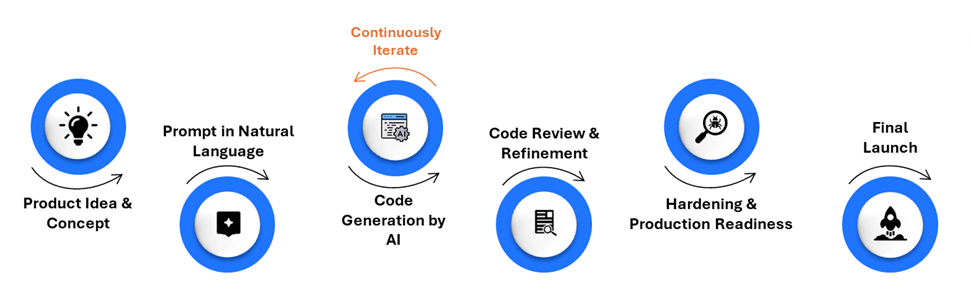
Before diving deeper, it’s helpful to visualize how AI assisted tools fit into a modern Business Analyst & development workflow. The process is no longer a linear sequence of capturing requirements, writing documents, handing them off, and waiting. Instead, it begins with a simple product idea or concept that the BA converts into a natural-language prompt. AI then generates the first version of the UI using the business logic provided by the BA, an iterative process, where each refinement brings the prototype closer to the desired user experience.
From there, teams review and refine the AI-generated output, strengthening workflows, correcting assumptions, and shaping the direction of the solution. Once the concept is validated, developers take the prototype through hardening, security checks, compliance review, and production-readiness steps before the final launch.
This end-to-end workflow shows how AI-assisted development accelerates early creation while still respecting the rigor required to ship real, reliable software. It demonstrates how natural-language prompts, rapid UI generation, and iterative refinement reduce miscommunication, speed up alignment, and narrow the gap between concept and implementation.
Staying Engaged Across the SDLC
With AI-powered tools, Business Analysts can now stay deeply involved throughout the software development lifecycle (SDLC). The SDLC stages below map directly to the workflow shown above, highlighting where each phase fits within an AI-assisted, iterative development process.
Discovery → Product Idea & Concept
- Build rapid prototypes in hours
- Facilitate workshops using interactive visuals
- Use AI-assisted documentation to turn notes into user stories
Discovery / Early Design → Prompt in Natural Language
- Translate early ideas into initial flows and UI concepts
- Create the first tangible version of the solution using natural-language prompts
Design → AI Code Generation (Continuous Iteration)
- Validate flows with stakeholders
- Update prototypes in real time
- Ensure alignment between business goals and technical feasibility
Development → Code Review & Refinement
- Clarify logic through living prototypes
- Provide developers with unambiguous visual references
- Use AI-generated test cases to support QA
Validation → Hardening & Production Readiness
- Trace requirements through prototypes, stories, and tests
- Validate behavior quickly through visual workflows
- Reduce defects through early feedback and iterative refinement
Validation / Business Sign-Off → Final Launch
- Confirm the solution meets the intended business outcomes
- Ensure what was built matches the validated prototypes
- Support stakeholder review and rollout readiness
Build Quickly with AI, but Always Verify and Harden for Production
While AI-assisted workflows like Vibe Coding can accelerate the journey from idea to working prototype, it’s important to recognize that AI-generated outputs may not be production-ready. These prompt-driven can ensure requirements are aligned at every step and speed up development, but it doesn’t replace the need for proper engineering practices, secure coding reviews, architectural oversight, or QA hardening as the generated code may not meet required standards for security, compliance, regulatory constraints, scalability, or maintainability.
This is why BA verification is essential, ensuring that what AI produces is directionally correct and that everything aligns with real business logic and user expectations before developers transform it into production-level implementations.
AI tools can interpret requirements, but they don’t always understand the nuances behind a workflow, a regulatory constraint, or a subtle edge case. That’s where human judgment comes in, and these AI outputs need to be reviewed with a critical eye to validate the following:
- Does the generated workflow reflect the actual business process?
- Are edge cases, exceptions, or compliance requirements handled?
- Is the UI intuitive for the target users?
- Will the backend logic support long-term scalability and reliability?
- Are there hidden assumptions made by AI that need correction?
AI can create the first draft, sometimes even a very good one, but BAs ensure it’s the right draft.
In short: Use AI to build fast but use your BA expertise to build right.
Conclusion: The BA Role is Entering Its Next Chapter
The Business Analyst of the future is not just a document creator but a proactive contributor and leader in product development. BAs are now:
- Visual modelers who create user flows and UIs through natural-language development
- Rapid prototypers who validate early concepts before code is written
- AI-assisted thinkers who turn ideas into structured user stories and test cases
- Collaboration catalysts who bridge business and development with tangible artifacts
- Strategic contributors who ensure every feature ties back to business value
This enhanced involvement throughout the SDLC not only speeds up time-to-market but also results in higher-quality products that deliver greater business value. Embracing this shift signifies an exciting new chapter for BAs as they take on dynamic, hands-on roles in shaping the future of software development.
The next generation of Business Analysts won’t just describe solutions.
They’ll build them.
