


AI-generated code is a starting point, not a finished product, and the developer who ships it is accountable for what it does.
Ask ChatGPT, Claude or Gemini to write a piece of code and you will usually get an impressive result within seconds. Then look at the chat box: all three tell you they can make mistakes.
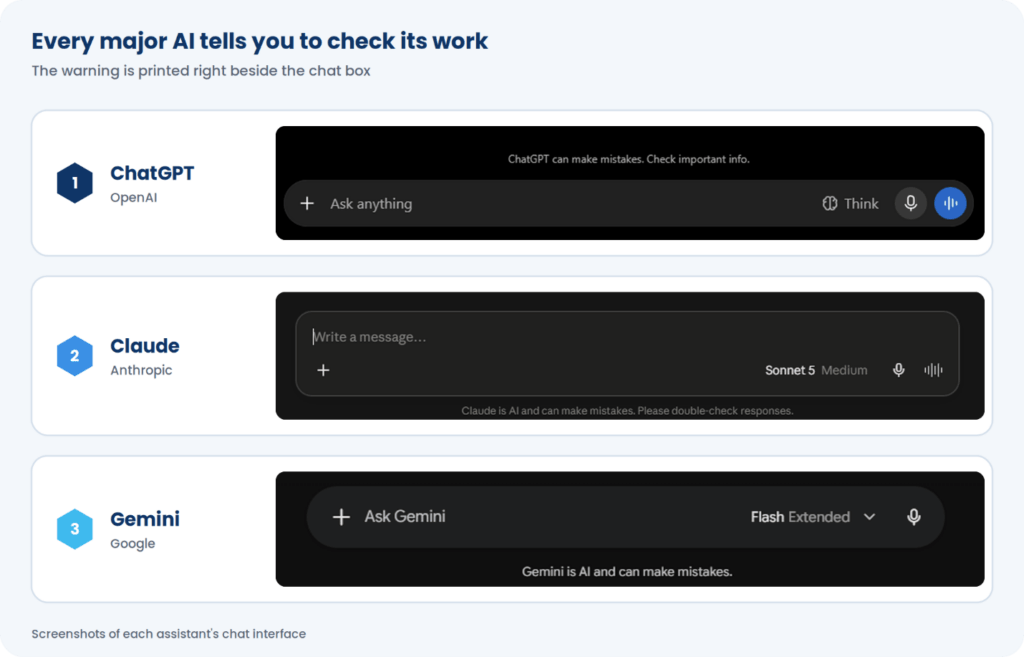
If the companies building these systems say to check their work, why would we copy, paste and ship their output unchecked?
If AI knows it can be wrong, why do we trust it with code?
Because it is fast and usually close to right. But close is not correct, and generated code can look professional while still being wrong.
Tools like GitHub Copilot produce drafts in minutes. The problem begins when speed is mistaken for correctness.
Imagine asking an AI for a login flow. It returns clean code, explains it confidently, and the application runs. But the code may never handle an expired session token, or it may skip a check that only matters under attack. Nothing fails in the demo. The flaw surfaces later.
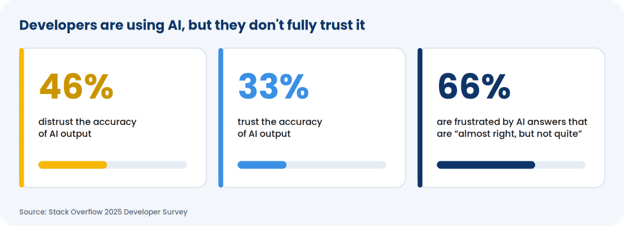
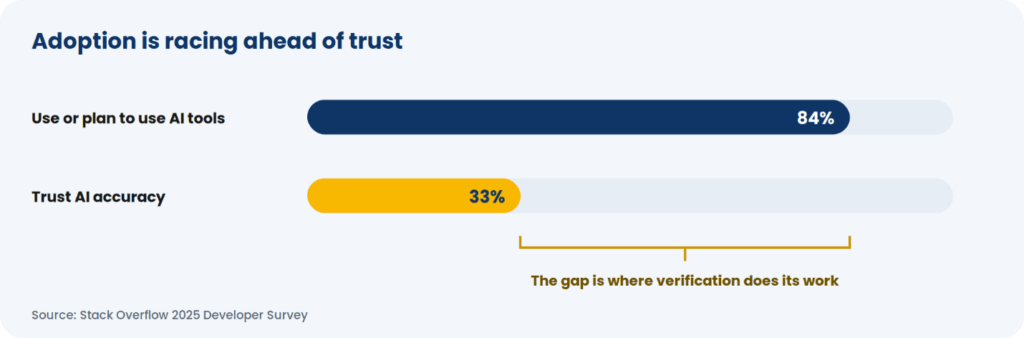
Stack Overflow’s 2025 Developer Survey found that 46% of developers distrust the accuracy of AI output, compared with 33% who trust it. Sixty-six percent are frustrated by solutions that are “almost right, but not quite.”
AI gives us a starting point. The mistake is assuming the starting point is the destination.
Why do hallucinations put AI code security at risk?
A hallucination is information an AI generates that is not actually true, and it arrives in the same confident tone as correct output. That is why AI code security cannot rest on how trustworthy the code sounds. A quick read will not catch a detail that is plausible but invented.
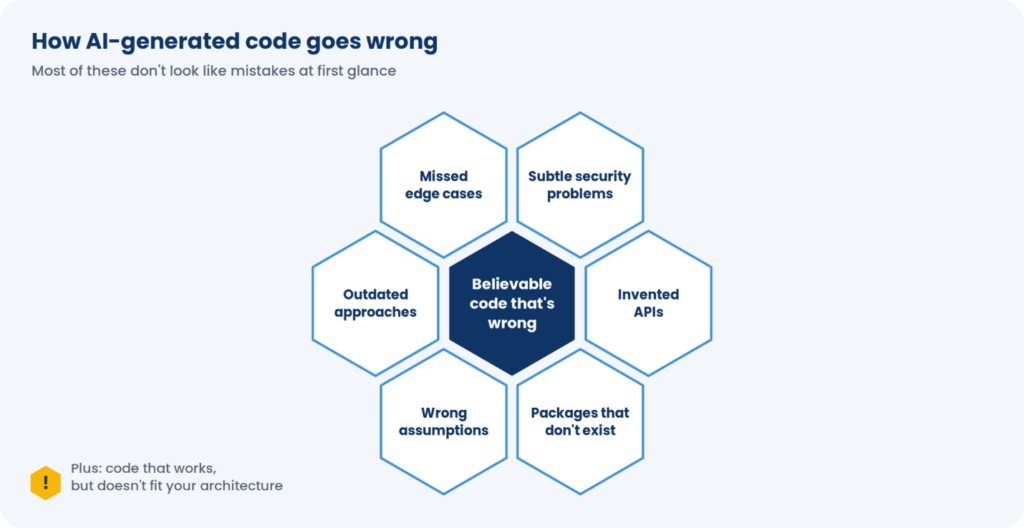
In software, that can mean an invented API, a misdescribed library feature or a package that does not exist. That last one is a security problem as well as a bug, because an attacker can register the invented name and wait for someone to install it. AI can also:
- Make incorrect assumptions about what you meant
- Recommend outdated approaches common in its training data
- Overlook unusual edge cases
- Introduce subtle security flaws, such as unvalidated input or hardcoded secrets
- Produce code that works but does not fit your architecture
The danger is not always broken code. Sometimes it is believable code solving the wrong problem.
What does verifying AI-generated code involve?
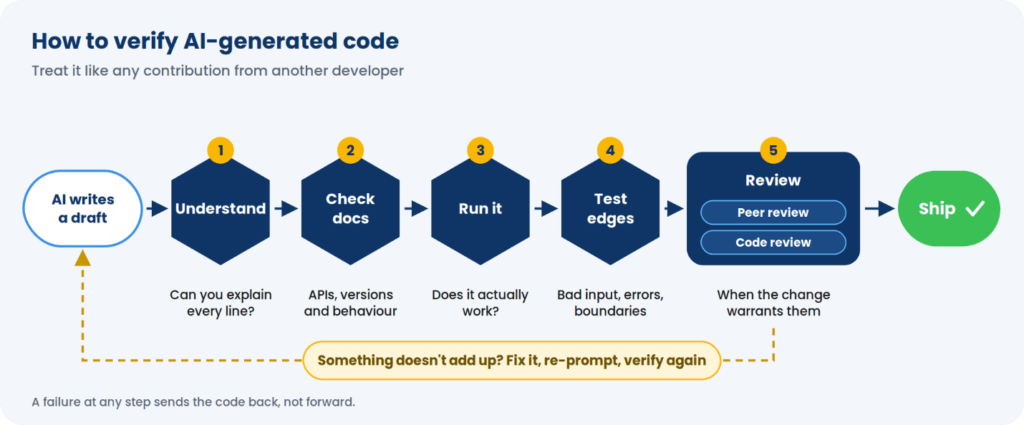
It means treating generated code like a contribution from another developer: understand it, run it, test it and have it reviewed. If you cannot explain fifty generated lines, you have gained fifty lines of responsibility, not capacity.
- Understand it: Ask why each important decision was made.
- Check the documentation: Compare APIs and behavior with the official docs, and confirm every package exists.
- Run it: Confirm it does what you asked, not just that it compiles.
- Test the edges: Cover invalid input, error handling and boundary conditions.
- Review it: Peer review questions the approach, and code review examines the changes, dependencies and security.
Tests in continuous integration, type checks, static analysis and dependency and secret scanning should run on every change, so reviewers can spend their time on judgment. Teams adopting AI in delivery can start with Verdentra’s AI and cognitive solutions practice.
AI can accelerate implementation. Verification decides whether that implementation deserves to survive.
What do ChatGPT, Claude and Gemini say about their own limitations?
ChatGPT, Claude and Gemini all state, right beside the chat box, that they can make mistakes. Their makers ask users to check important information instead of trusting responses blindly.
OpenAI says ChatGPT can produce incorrect or misleading answers. Anthropic acknowledges that Claude can make mistakes, including high-stakes ones. Google’s Gemini guidance is plainer still: AI can and will make mistakes, so check responses against reliable sources.
These warnings do not come from people who dislike AI. They come from the organizations building it, and that should change the question we ask: not whether AI can write this code, but how we know the code is correct.
How does the developer’s role change when AI writes more of the code?
Developers spend less time typing and more time judging. Their job shifts from writing every line to deciding which lines should exist and owning those decisions.
Less time goes into repetitive implementation. More time goes into:
- Describing requirements precisely enough for the AI to follow (prompting)
- Examining generated solutions
- Testing behavior against real conditions
- Deciding whether an implementation is appropriate
Treat AI like a fast contributor who does not know your system. You would not merge a large pull request from that person without understanding, testing and reviewing it, and the volume of generated code makes that matter more.
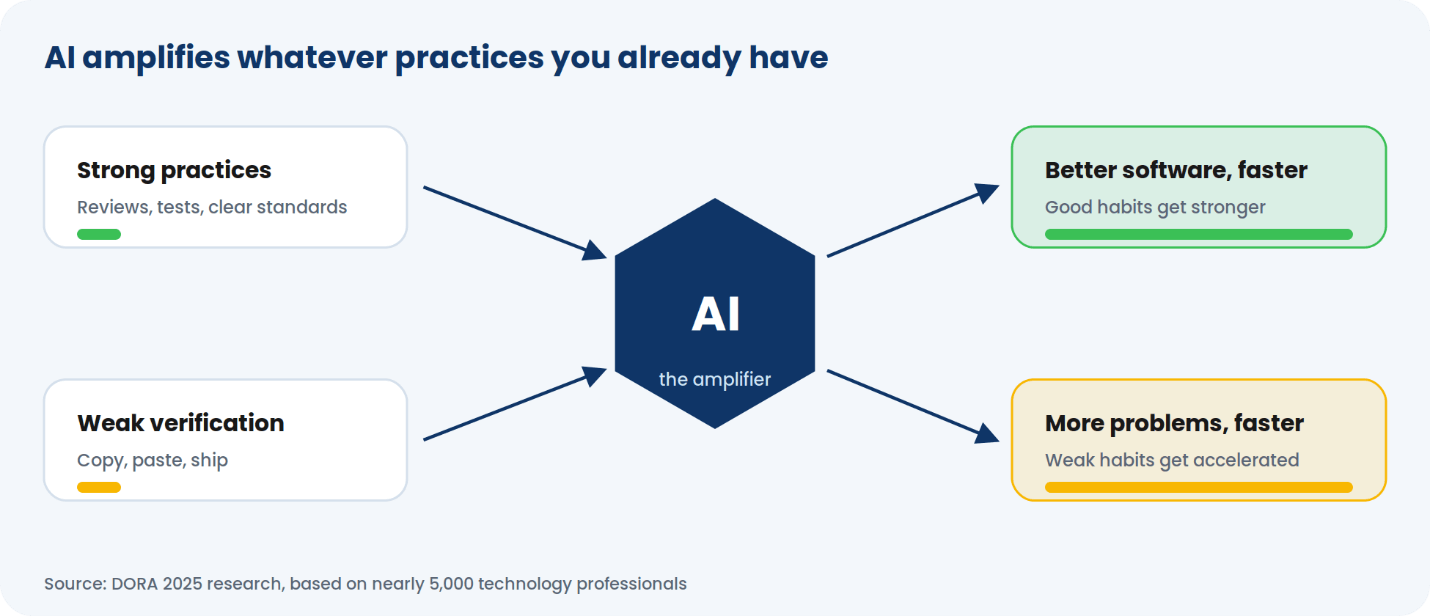
DORA’s 2025 research, based on nearly 5,000 technology professionals, describes AI as an amplifier of existing organizational strengths and weaknesses. Strong practices get stronger. Weak verification gets faster.
Is AI the brush, and the developer the artist?
Yes. Like a brush, AI makes the work faster and smoother, but it does not decide what is being made. The developer does, and the developer owns the result.
If the final picture is poor, the artist cannot blame the brush. The same is true when a security hole ships in generated code: the commit carries a developer’s name, not the model’s.
AI can produce the first sketch, fill in repetitive detail and suggest another approach, but it cannot know your requirements, your customers or your constraints. The developer still decides what belongs in the final picture: understanding requirements, questioning assumptions, verifying details and judging whether the result is safe and maintainable.
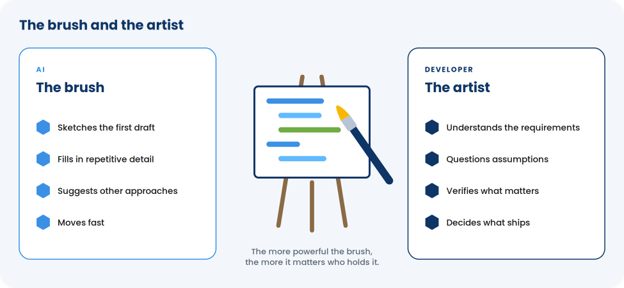
The more powerful the brush becomes, the more it matters who holds it.
Who is accountable when AI-written code fails in production?
The developer who shipped it. AI does not take responsibility for the code it generates, and when that code reaches production the person who merged it owns the outcome.
It is tempting to think otherwise: the model wrote it, so the model is responsible. It is not. Users do not care who or what typed the code. They care whether the software works. Accountability comes down to a few habits:
- Never merge code you cannot explain
- Say in the pull request when AI helped
- Hold generated code to the same standards as any other change
- Keep secrets and customer data out of prompts unless your policy allows it
- Treat unfamiliar dependencies as unapproved until someone checks them
Stack Overflow’s 2025 survey shows the tension: 84% of respondents use or plan to use AI tools in development, while trust in their accuracy remains far lower.
AI does not make engineering judgment obsolete. It makes it more valuable.
Treat generated code like any other contribution
AI-assisted development is not a replacement for developers. It changes where they spend their effort.
AI can write the first version, explain an unfamiliar API, suggest a test and even find problems in existing code. None of that means its output should be trusted automatically. Generated work has to pass the same engineering discipline as everything else, and anything that ships should be something its author can explain, prove and answer for.
Verifying AI-generated code is not overhead on top of the real work. For teams shipping with AI, it is the real work.