


Quality Assurance has always been the backbone of reliable software delivery. No matter how innovative an application is, its success ultimately depends on how stable, secure, and user-friendly it feels in the hands of real users. Traditionally, QA was viewed as a phase that occurred after development, focused mainly on finding bugs before release. However, as software development has evolved toward agile, DevOps, and continuous delivery models, QA has transformed into a continuous, end-to-end activity. In this transformation, Artificial Intelligence (AI) has emerged as a powerful force that is redefining how quality is planned, built, validated, and maintained.
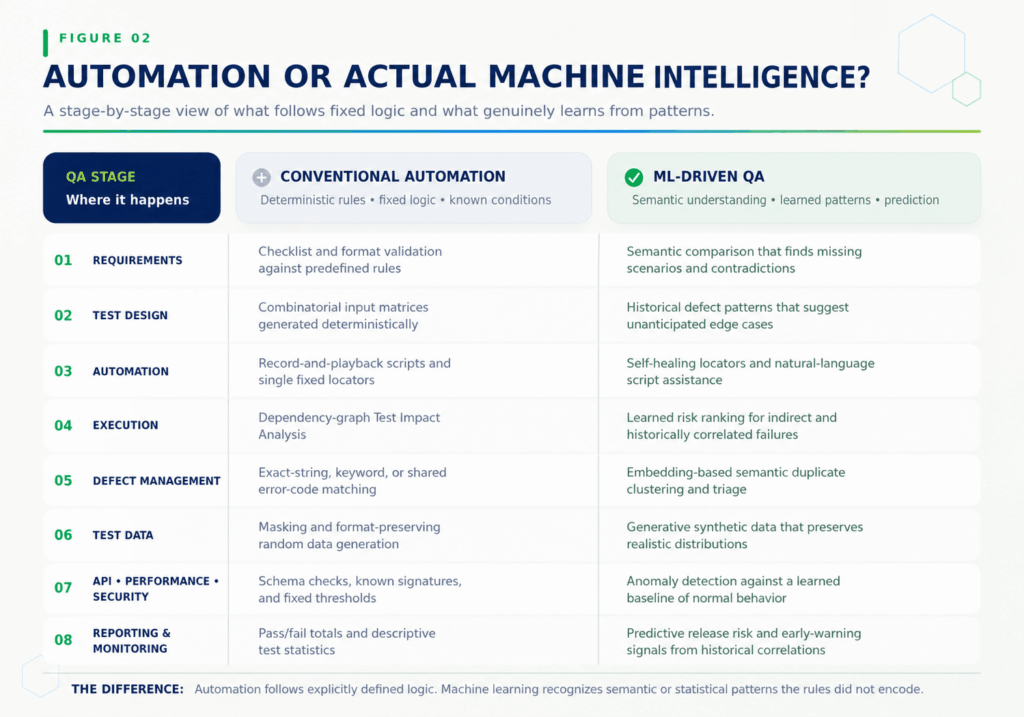
It’s worth being precise from the outset, though: “AI” in QA conversations often covers everything from genuine machine learning models to plain rule-based scripts that have simply been rebranded, and understanding the difference is what separates real capability from marketing language.
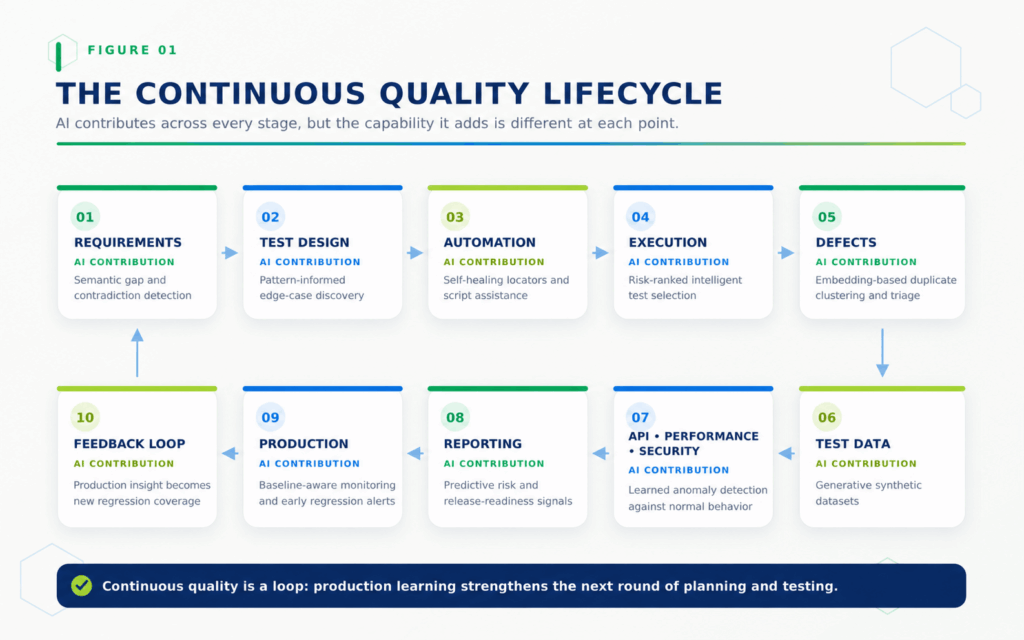
A useful way to see this transformation is to picture it as a lifecycle: requirements flow into test design, which flows into automation, execution, defect management, test data, API and performance and security testing, reporting, and finally production feedback that loops back into planning. AI touches every one of these stages, but not evenly, and not always in ways that are genuinely new. The sections below walk through that lifecycle stage by stage, with a distinction between what conventional automation already does and what actually requires machine intelligence.
Requirement Analysis and Test Planning
The influence of AI begins at the very first stage of the QA process: requirement analysis and test planning. Requirements are often written in plain language and may be influenced by business constraints, time pressure, or evolving stakeholder expectations. As a result, they frequently contain ambiguities, missing acceptance criteria, or assumptions that are not immediately obvious.
This is a genuine natural language processing problem: an AI model can be given a story’s acceptance criteria alongside its linked PRD and asked to flag scenarios described in the PRD that never made it into the acceptance criteria, catching gaps a keyword search would miss entirely because it requires understanding meaning, not just matching words. A simple checklist that flags a story missing a “Definition of Done” section is rule-based automation, not AI. The genuinely new part is semantic comparison between two documents to catch a contradiction that isn’t a keyword match.
Test Design
As the process moves from planning into test design, AI continues to play a crucial role. Writing test cases manually is a skill-intensive task that depends heavily on the tester’s experience and understanding of the system, and even experienced testers can miss edge cases under tight sprint timelines.
AI enhances test case design by analyzing application workflows, historical defects, user behavior, and existing test repositories. A model trained on a defect corpus, for example, might notice that boundary conditions around currency rounding have produced defects in three prior modules, and proactively suggest a boundary-value test for a new currency field even though nobody explicitly asked for one. It’s worth noting that generating a standard combinatorial matrix of input values is a deterministic algorithm that has existed for decades and requires no machine learning at all; what’s new is pattern-matching against unstructured historical defect text to surface scenarios a combinatorial matrix wouldn’t think to include.
Test Automation
Test automation is one of the most visible and impactful areas where AI has changed the QE landscape, and it’s also where the gap between marketing language and technical substance is widest. Automation has long promised faster testing and quicker feedback, but in practice many teams struggle with unstable scripts and high maintenance overhead, where minor UI changes, dynamic elements, or locator updates cause entire suites to fail.
Self-healing frameworks such as Helenium, Testim, and Applitools’ visual AI address this by capturing multiple candidate locator strategies for each element – CSS selector, XPath, visible text, relative position, and a visual snapshot – and using a similarity-ranking model to pick the closest matching element when the primary locator breaks. If a button’s id changes after a refactor, a self-healing tool recognizes the element occupies the same position and carries the same label and updates the locator automatically instead of failing the run.
AI can also generate test scripts directly from natural language: a QE engineer can paste a TestRail case’s steps into a properly configured prompt and get back a working Playwright spec, though it still needs human review before merging. Record-and-playback tools, by contrast, have existed for two decades and are pure automation with no adaptability at all – they replay exact recorded steps and nothing more. Beyond authoring, AI also helps teams decide what to automate in the first place, analyzing execution history, defect detection rates, and maintenance effort to recommend which test cases are worth automating and which cost more to maintain as scripts than they save.
Test Execution
During test execution, AI significantly improves speed and efficiency, though again it’s worth separating two different approaches that both get called “intelligent test selection.” In large systems with thousands of test cases, running the entire suite for every code change is often impractical.
The conventional approach is Test Impact Analysis: a dependency graph, built from static or dynamic code coverage, maps which tests exercise which code paths, so a commit touching a specific file trigger only the tests known to cover it. This is deterministic graph traversal, not machine learning. A genuinely ML-driven approach goes further, learning correlations a dependency graph can’t see – for instance, that changes to a shared date-parsing utility have historically broken three seemingly unrelated report-export tests, even though static analysis shows no direct dependency, because the actual link runs through a shared library invoked at runtime under specific data conditions. Most mature CI/CD pipelines combine both: dependency-graph selection for guaranteed coverage, layered with an ML-ranked tier for changes that are statistically likely to cause trouble elsewhere.t foundation, its benefits may be offset by the cost of adoption and maintenance.
Defect Management
Defect management is another domain where AI adds substantial value. Traditional defect management relies heavily on manual triaging, where QE engineers review failures, compare them with existing bugs, and assign priorities – a process that can be subjective and time-consuming, particularly across large projects.
AI-powered tools use text embeddings, numerical representations of a bug description’s meaning, to compare new reports against the existing backlog. Two bugs worded completely differently might describe the exact same underlying defect, and a high similarity score between their embeddings flags them as likely duplicates for a human to confirm, even though they share almost no exact keywords. Exact string matching or matching on a shared error code is simple automation; recognizing that two differently worded reports describe the same underlying issue requires genuine semantic understanding.
Test Data Management
Test data management, often considered one of the most challenging aspects of QE, also benefits from AI, though here too the distinction between old and new techniques matters. High-quality test data is essential for validating real-world scenarios, but accessing production data introduces privacy, security, and compliance risks.
Simple data masking – replacing a real value with a random one in the same format – is deterministic and has nothing to do with AI. What genuinely requires machine intelligence is generative synthetic data: a model trained on the statistical distribution of a production dataset, such as customer order records, can produce thousands of synthetic records that preserve realistic distributions of values, customer types, and edge cases like a zero-dollar order or a negative refund amount, without any single synthetic record being derived from a real customer.
API, Performance, and Security Testing
In API, performance, and security testing, the AI value-add follows a common pattern: it’s about anomaly detection against a learned baseline, not the mechanics of running the test itself.
In API testing, a model that has learned the normal shape of a response can flag one that’s structurally valid but statistically unusual, such as a field that’s always positive suddenly returning a negative value, which a pure schema check would miss because the response is technically well-formed. In performance testing, rather than running a fixed load profile on a fixed schedule, a model trained on historical traffic and load-test results can flag when a fresh test is warranted and suggest a load profile that mirrors real observed usage. In security testing, static rule-based scanners checking for known vulnerability signatures remain the workhorse and aren’t AI at all; what machine learning adds on top is behavioral anomaly detection that can flag a sequence of requests that doesn’t match any known attack pattern but deviates significantly from normal usage.
Reporting and Analytics
One of the most significant contributions of AI to QE is reporting and analytics. Traditional test reports often present large volumes of data but offer limited insight into what that data actually means.
AI transforms raw test results into predictive signals rather than descriptive statistics – correlating current results, code churn, and historical defect density to produce a release-readiness score or flagging that a module’s rising flaky-test rate has historically preceded a spike in production incidents by two or three sprints. This data-driven approach elevates the role of QE from execution-focused to strategy-driven, enabling better decision-making across the organization.teams.
Production Monitoring and the Feedback Loop
Effective quality assurance rarely relies on a single to AI’s role in quality assurance does not end at release. In production, AI-powered monitoring tools analyze logs, system metrics, and user behavior in real time, recognizing deviations from a learned normal baseline rather than relying on hard-coded thresholds, which allows teams to catch a quality regression before a support ticket is ever filed.
Insights gathered from production feed back into test planning and design, creating a continuous quality feedback loop where an anomaly in a specific module becomes the seed for a new regression test case. This shift toward continuous quality assurance ensures that testing is not a one-time activity but an ongoing process that evolves with the product.
A Sequenced Adoption Roadmap
For a team deciding where to actually start, adopting AI across every stage at once is a good way to waste a budget. A sequenced rollout tends to work better:
1. Test case generation and requirement analysis – low risk, easy to validate by hand.
2. Automation assistance – self-healing locators on an existing suite, AI-assisted script generation for new coverage.
3. Defect triage and duplicate detection – high-volume and repetitive enough to show a clear win once there’s sufficient historical data.
4. CI/CD execution optimization – once there’s enough historical run data to tune a selection model meaningfully.
5. Predictive and production intelligence – layering release-readiness scoring and anomaly detection on top of everything else.
At every stage, AI output still needs human validation before it’s trusted in a release decision – a generated test that passes doesn’t guarantee it tests the right thing and treating AI as a fast first draft that a qualified engineer reviews, rather than an autonomous decision-maker, is what keeps the productivity gains from turning into quietly degraded coverage.
Where AI Earns Its Place in QA
Artificial Intelligence is genuinely transforming the Quality Assurance process from start to finish, but the value is concentrated in specific, identifiable capabilities – semantic understanding of requirements, similarity-based locator healing, embedding-based defect clustering, generative synthetic data, and predictive risk scoring – rather than spread evenly across every corner of the lifecycle.
Distinguishing those capabilities from conventional automation that has simply been rebranded is what lets a QA team invest its effort where AI actually earns its keep. The future of QA lies in a balanced partnership between humans and intelligent systems, where AI handles repetitive, pattern-heavy, and predictive work, while humans bring critical thinking, creativity, domain judgment, and empathy for the end user. Organizations that embrace this approach, and sequence their adoption deliberately, will be best positioned to succeed in an increasingly competitive and fast-paced digital world.